

VERIFIED CALCULATOR
Enter four facial measurements to estimate your closest face shape and explore styling ideas.
YOUR ESTIMATE
Oval face shape
This is an estimate based on the proportions entered and the selected feature description. There are no universal numerical cutoffs for face shapes. If your result feels borderline, repeat your measurements and compare it with your visible facial outline.
A Face Shape Calculator helps you identify your face shape by comparing your forehead, cheekbones, jawline, and face length. The result can help you narrow down hairstyles, glasses, and other personal styling choices that suit your facial proportions. Common categories include oval, round, square, oblong, heart, diamond, and triangle.
You can estimate your shape by measuring your face or examining its outline in a mirror. In this guide, you’ll learn how to use a face shape calculator, take accurate measurements, recognize each shape, and interpret your result when your features fall between two categories.
Key Takeaways
- A Face Shape Calculator compares forehead width, cheekbone width, jawline width, and face length to estimate your closest face shape.
- The seven common categories are oval, round, square, oblong, heart, diamond, and triangle.
- You can measure your face at home using a ruler or flexible measuring tape and a mirror.
- Your result is an estimate, since many faces have features associated with more than one category.
- Face shape can help guide hairstyle and glasses choices, but comfort and personal preference matter more than a label.
What Is a Face Shape Calculator?
A Face Shape Calculator is an online tool that estimates your face shape from facial proportions or a photograph, depending on the tool’s features. A measurement-based calculator compares the width of your forehead, cheekbones, and jawline with the length of your face.
The result identifies the category that most closely matches your proportions. This can help you narrow down styling options without relying entirely on a mirror or selfie.
A face shape result is a styling guide, not a medical assessment or a measure of attractiveness. Your face may share characteristics with several categories, so use the result as a starting point rather than a permanent label.
How to Use the Face Shape Calculator
You can use a face shape calculator by entering four facial measurements. Follow these steps to get a useful estimate.
- Measure your forehead width. Find the widest part of your forehead and measure straight across.
- Measure your cheekbone width. Measure across the widest points of your cheekbones.
- Measure your jawline width. Measure straight across between the two jaw angles below your ears.
- Measure your face length. Measure vertically from the center of your hairline to the bottom of your chin.
- Enter your measurements. Use the same unit for all four values, such as centimeters or inches.
- Review your result. Compare the suggested shape with the visible outline of your face.
If your result seems inaccurate, repeat the measurements before selecting another category.
How to Measure Your Face Shape at Home
Accurate measurements make it easier to compare your facial proportions. You need a mirror, a ruler or flexible measuring tape, and a way to record your measurements.
Pull your hair away from your forehead and cheeks. Face the mirror directly, keep your head level, and relax your facial muscles. Measure each distance in a straight line rather than following the curve of your skin.
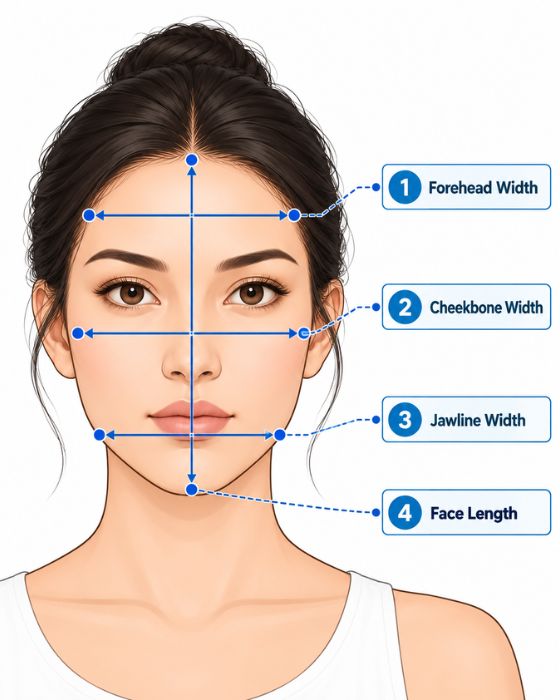
| Measurement | Where to measure |
| Forehead width | Across the widest part of your forehead, usually near the temples. |
| Cheekbone width | Across the most prominent points of your cheekbones. |
| Jawline width | From one jaw angle to the other, below your ears. |
| Face length | From the center of your hairline to the bottom of your chin. |
Measure each distance twice. If the values differ, take another measurement and use the most consistent result. If your hairline is difficult to identify, record that limitation when interpreting your face length.
What Are the Seven Common Face Shapes?
The seven common face shapes are oval, round, square, oblong, heart, diamond, and triangle. Each category describes a typical combination of facial length, width, and outline.
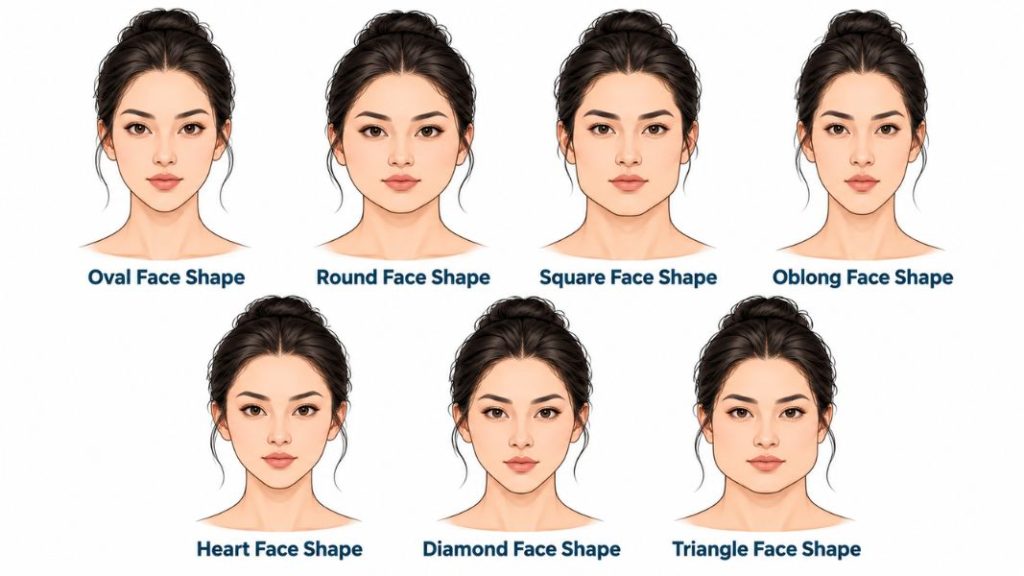
1. Oval Face Shape
An oval face shape is typically longer than it is wide, with cheekbones that are slightly wider than the forehead and jawline. The jaw usually narrows gently toward the chin rather than forming strong, sharp corners.
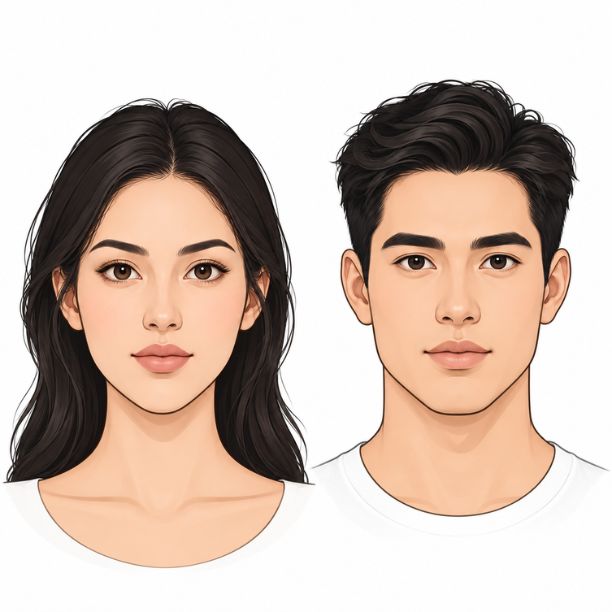
Your face may be oval if its outline looks balanced from forehead to chin, with no single area appearing much wider than the others. Some oval faces have more angular features, so the overall proportions matter more than one feature alone.
2. Round Face Shape
A round face shape has a relatively short appearance, fuller cheeks, and a softly curved jawline. The face length and width may be similar, and the outline tends to lack prominent corners.
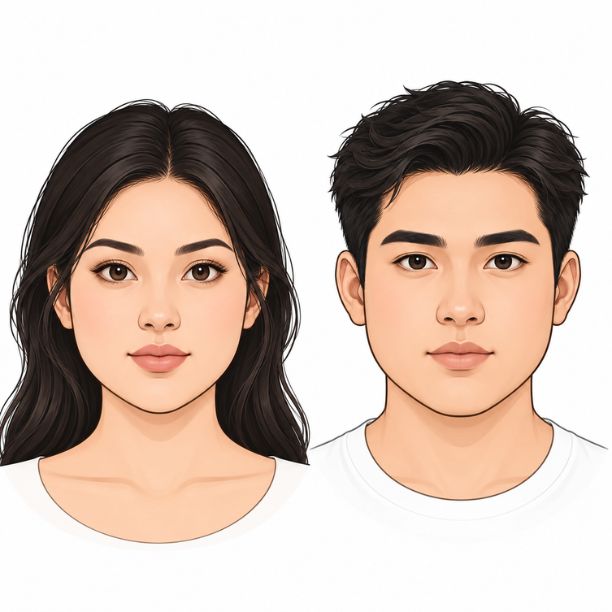
Look at the sides of your face and the area around your chin. If the outline curves smoothly from the cheeks to the jaw, your features may fit the round category. A full cheek area alone does not confirm this shape, since other face shapes can have full cheeks too.
3. Square Face Shape
A square face shape often has a broad forehead, prominent jaw angles, and a relatively straight outline along the sides. The face length and width may be similar, giving the face a more angular appearance.
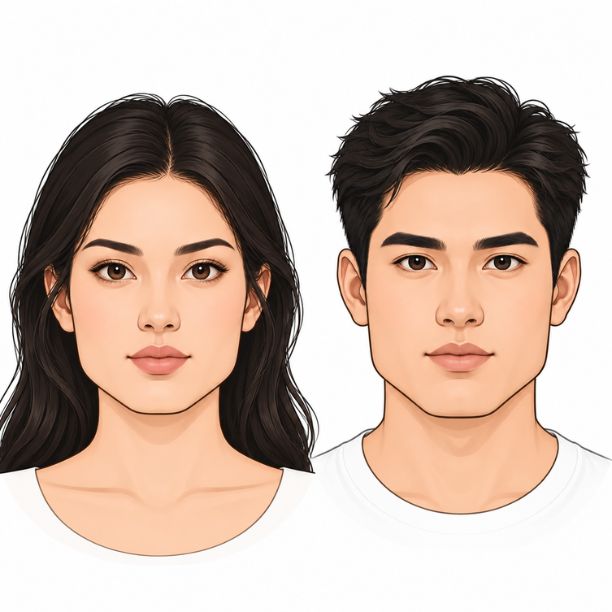
The jawline is a useful feature to check. If the jaw is broad and its corners are clearly defined, your face may fit the square category. A square face can be longer than it is wide, so consider both the overall proportions and the shape of the jaw.
4. Oblong Face Shape
An oblong face shape, sometimes called rectangular, is noticeably longer than it is wide. The forehead, cheeks, and jaw may have similar widths, creating a relatively straight outline down the sides.
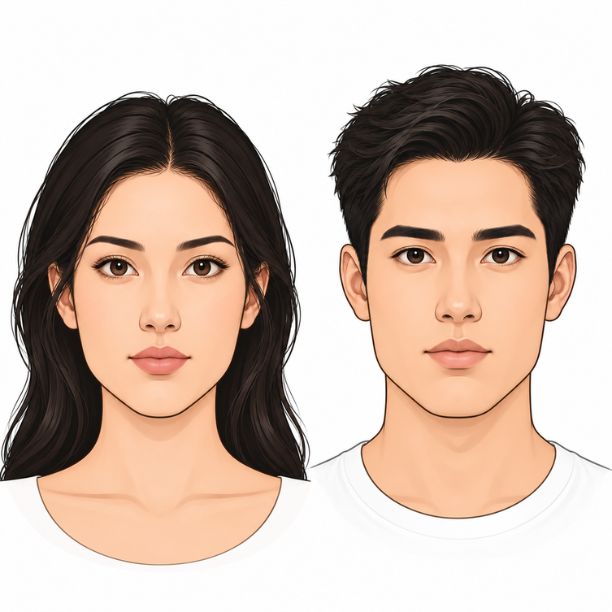
The main clue is the length of your face compared with its width. An oblong face may have an angular jaw or a softer outline. This distinguishes it from an oval face, which often has a more tapered appearance around the forehead and chin.
5. Heart Face Shape
A heart face shape typically has a wider forehead and a narrower lower face, with the chin tapering to a relatively small point. The cheekbones may be prominent, and the jawline often narrows toward the chin.
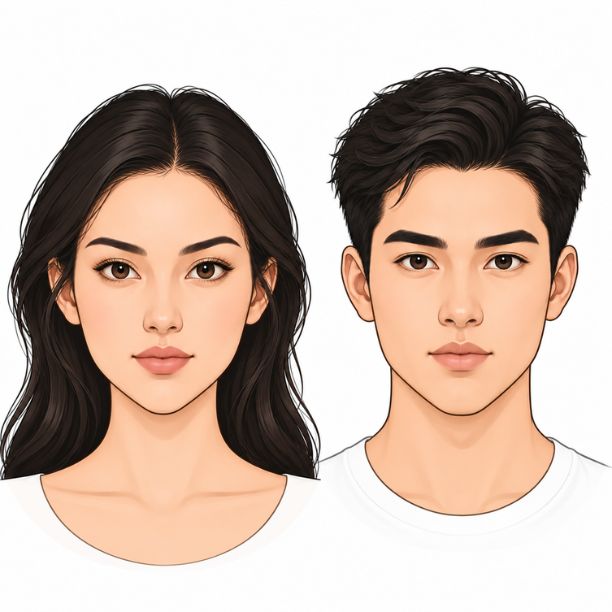
Check whether your forehead is one of the widest parts of your face. Then look at the outline from your cheeks to your chin. A clear narrowing toward the lower face supports a heart-shaped appearance, though not every heart-shaped face has a sharply pointed chin.
6. Diamond Face Shape
A diamond face shape usually has prominent cheekbones, with a narrower forehead and jawline. The face may taper both upward and downward from its widest point, creating a more angular outline.
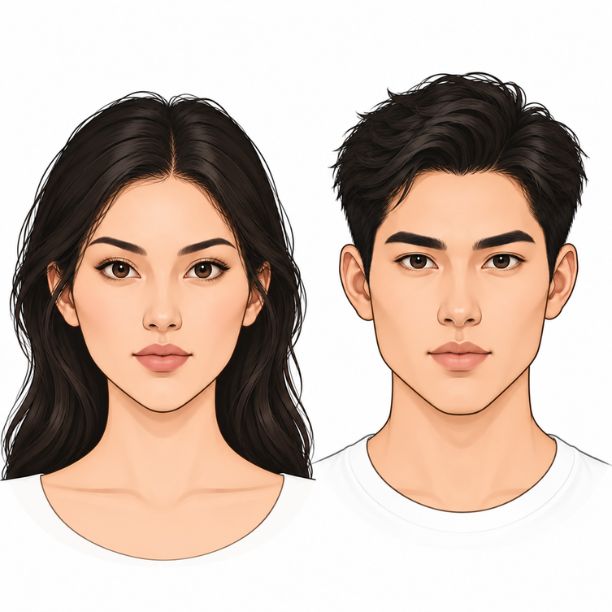
Compare all three width measurements. If your cheekbones are noticeably wider than your forehead and jaw, the diamond category may be a close match. A narrow chin alone does not establish this shape; the relative width of the cheekbones is a key clue.
7. Triangle Face Shape
A triangle face shape typically has a jawline that is wider than the forehead. The lower part of the face appears broader, with the outline narrowing as it moves upward.
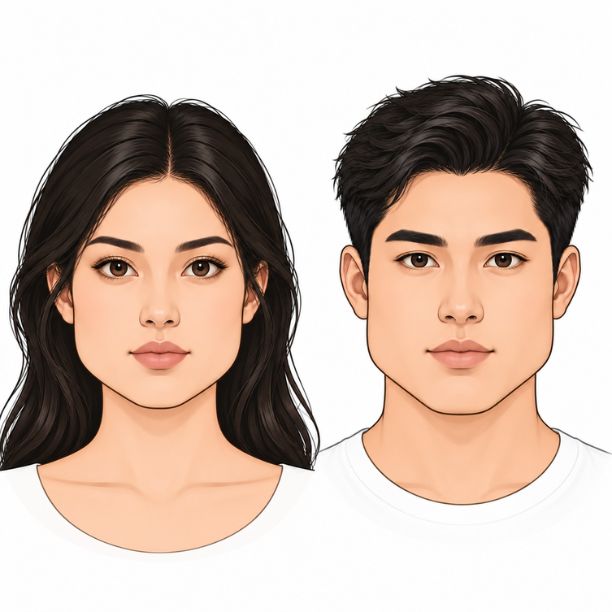
Look at the width of your jaw in relation to your forehead and cheekbones. If the jaw is the broadest area, the triangle category may fit your features. Some triangle-shaped faces have a rounded jaw, while others have more defined angles, so the outline can vary.
How Does a Face Shape Calculator Determine Your Result?
A measurement-based calculator compares the four values you enter and checks which facial proportions best match its classification rules.
The main comparisons are:
- Forehead width: Shows how broad the upper part of your face is.
- Cheekbone width: Helps identify whether the middle of your face is the widest area.
- Jawline width: Shows whether the lower face is relatively broad or narrow.
- Face length: Helps distinguish shorter, rounder proportions from longer proportions.
Some calculators use fixed rules. Others compare several proportions and select the closest match. Photo-based tools may estimate facial landmarks from an image instead of asking you to enter measurements.
There is no single universal set of numerical cutoffs for all face shapes. A calculator’s result depends on its classification method, and a small measurement difference can change a borderline result.
What If Your Face Shape Matches Two Categories?
It is normal for your features to overlap between two face shapes. For example, you may have the length of an oval face with the straighter sides of an oblong face. You may have prominent cheekbones associated with a diamond shape and a jawline that resembles a square shape.
Use these checks to narrow down the closest match:
- Compare your three width measurements to find the broadest area.
- Check whether your face looks relatively short, balanced, or long.
- Examine the jawline to see whether it is rounded, angular, or tapered.
- Repeat any measurements that are close together.
- Compare the result with a straight-on photograph taken at eye level.
If two categories still seem accurate, keep both in mind. You do not need to force your face into one exact category to make useful styling choices.
How Can Your Face Shape Help You Choose Hairstyles and Glasses?
Your face shape can give you a starting point for comparing different hairstyles and glasses frames. The goal is to identify options you like and see how they work with your features.
| Face shape | Hairstyle ideas to explore | Glasses styles to explore |
| Oval | Short, long, or layered cuts that preserve your preferred proportions. | Rectangular, round, or geometric frames. |
| Round | Layers or added height that create a longer visual outline. | Rectangular or angular frames. |
| Square | Soft layers, textured styles, or cuts with movement around the jaw. | Rounded or oval frames. |
| Oblong | Side volume, fringe, or styles that create a wider visual balance. | Taller frames or wider styles. |
| Heart | Side-swept fringe or styles that add visual balance around the lower face. | Oval, round, or lighter lower-rim styles. |
| Diamond | Layers or fringe that work with prominent cheekbones. | Oval, cat-eye, or rim styles that complement your features. |
| Triangle | Styles that add volume around the forehead or upper sides. | Frames that draw attention toward the upper part of the face. |
These are starting points, not strict rules. Frame fit, comfort, prescription requirements, hair texture, and your personal taste should guide your final choices.
Common Face Shape Measurement Mistakes
Small measurement errors can affect your result. Avoid these common problems when using a face shape calculator.
- Measuring around the face: The calculator needs straight-line widths, not the distance around the curved surface.
- Mixing units: Enter all measurements in centimeters or all in inches.
- Tilting your head: A tilted position can make your face length and width harder to compare.
- Leaving hair over the forehead: Hair can hide the hairline or make the forehead look wider than it is.
- Relying on a close selfie: Camera distance, lens distortion, and head angle can change the apparent proportions of facial features.
- Treating the result as exact: Face shapes overlap, and different calculators may use different classification rules.
For a more consistent comparison, measure your face in the same position each time and use a clear, straight-on view.
Frequently Asked Questions
Can I find my face shape without uploading a photo?
Yes. Measure your forehead, cheekbones, jawline, and face length with a ruler or flexible tape. Enter the four values into a measurement-based calculator to estimate your closest face shape.
Does facial hair affect a face shape calculator result?
Facial hair can change the visible outline of your jaw and chin, especially in photographs. Measure your underlying facial proportions when possible, or interpret a photo-based result with that limitation in mind.
Can my face shape change as I get older?
Your visible facial proportions can change with age as facial tissues and fullness change. A face shape label may shift, though these categories remain approximate descriptions rather than fixed personal traits.